





Supported by NTT DATA   Earth
Topics: [Report] #41 Sustainable City - A sustainable society can be realized! (2008.09.02)
 
Home News Report Emergency Yournews About Think Daily Japanese
 
#29   Nurturing the Forest, Nurturing People - Efforts of the "Furano Shizen Juku" (Furano Nature School)

Furano-city is found on Hokkaido, the largest island (and prefecture) located in northern Japan. And the "Furano Shizen Juku (Furano Nature School)" based at what used to be the Furano Prince Hotel Golf Course has been engaging in activities many have become fascinated with.
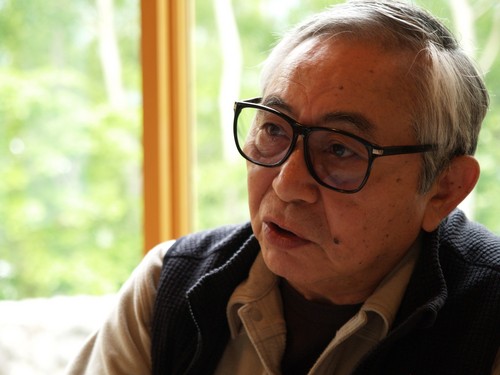
The Furano Prince Hotel Golf Course was a distinguished golf course renowned also for its designer, Arnold Palmer. And here at this former golf course the Furano Shizen Juku plans to plant 150,000 trees in the next 50 years on some 35 hectares of land amounting to 6 of the 18 holes, in order to return this maimed land to its original sylvan state. Interactive environmental education courses are also being held here. The founder and acting principal of the "Furano Shizen Juku" is the esteemed scriptwriter Mr. So Kuramoto.
We went to Furano, which looks upon Tokachidake and Daisetsurenpou, in the early days of summer to talk to Mr. Kuramoto about the "Furano Shizen Juku," which just got up and running.


CONTENTS

# Learning about Earth's miracles and opening doors
# Everything begins with experience - Environmental Education Program
  + 10 million years per step - treading steadily on the "Earth's Path"
  + Stimulating the imagination - the importance of the art of communication
# Why plant trees? - Return to Nature Program
  + The forest is trying to revive itself with its own strength
# A large steppingstone for changing the future selection of development sites
# Come to Furano


# Learning about Earth's miracles and opening doors

The former Furano Prince Hotel is located at the foot of Furano Nishidake, an hour drive from Asahikawa Airport. The field of the "Furano Shizen Juku" lies just behind the Prince Hotel, and its activities may be divided into 2 main pillars. One is the "Return to Nature Program," a tree-planting program which will help rejuvenate the nature's ecosystem. The second is the "Environmental Education Program," which conducts workshops using the various mechanisms placed within the field so that people may feel and experience the importance of nature.
The activities only fully began in June this year; yet nearly 2,000 people have already taken part in the programs.

"The Earth is a miraculous planet different from the others. That is why we must cherish it. I want people to understand this not only in their head, but also with their body. I want them to feel it." says Mr. Kuramoto.
"And I want to change the nature of learning. There is no need to go into a forest and remember all the names of the trees you'll find. You can learn that when you feel that you want to. First, you should experience the mysteries of the Earth, and to get to know the core substance. We believe that the activities of the Shizen Juku are like edoors that awakens you to the environment.' If you open the door and its pitch black inside, don't just go home. Let us jump into the pitch darkness."


#  Everything begins with experience - Environmental Education Program

We understood the meaning of Mr. Kuramoto's words when we experienced the programs offered by the "Furano Shinzen Juku." Rather, in truth you cannot understand what he means unless you experience it for yourself.

The "Environmental Education Program", which forms one of its pillars of activity, begins by holding our breaths and revisiting our undeniable need for oxygen. Of course it becomes painful to hold our breath for more than a few dozen seconds; we are an organism that would die in 2, 3 minutes if deprived of oxygen. And we are taught that it is the leaves on the trees of the forest that produce this oxygen. We realized this as we listened to the sound of the leaves as they swayed in the wind. But this moment of realization was like being hit over the head by the natural environment that surrounded us; it was truly an awakening moment.

Then we experienced a few processes that helped us regain our five senses. For people living in the megalopolis intoxicated with excessive stimuli of smell, sense of touch, and vision in their daily lives, the process of regaining the five senses is like a pre-education warm-up exercise. Afterwards, we learned about what an miraculous planet the Earth really is, and how it exists on a delicate fragile balance through learning about the distance between the Earth and the moon and sun, its size and the relationship with gravity, and the ratio of the surface area forests and the seas covers on Earth. By using the stone objets that freckle the forests, the program depicts the Earth in clear and visceral expressions. "We thought we knew about" our home, but this program was full of surprises about the planet Earth.

The participants walked blindfolded along the "barefoot path" while calling out to one another. Not only did we experience the sensation with the soles of our feet, but our senses besides our sight such as our sense of touch and hearing were instantly reawakened/sharpened.
The 1-meter stone Earth placed in the field is one of the teaching materials for the outdoor class. This photograph is of Mr. Hiromitsu Hayashibara, the vice-principal of the "Furano Shizen Juku" who gave us the guided tour.
 
The moon expressed using the same relative scale as in space is placed approximately 30 meters away from the 1-meter stone Earth.
It was a very magical experience; it felt as though we were floating in space with a panoramic view of the Earth and moon. "At this scale, the sun is approximately 12 kilometers away. It would be somewhere over there" so saying, Mr. Hayashibara pointed into the distance beyond the forest throwing our imagination into full throttle. Mr. Kuramoto initially had thought of flying a balloon 12 kilometers away to mark the location of the sun.


+  10 million years per step - treading steadily along the "Earth's Path"

The best experience of the "Environmental Education Program" is the walk along the "Earth's Path". The "Earth's Path" highlights 4.6 billion years of Earth's history along a 460-meter path. When we were told that "each step equaled 10 million years," our feet seemed to feel heavier.
Through our 30-minute walk along the path while listening the explanations, we were able to holistically grasp with our senses the extensive history of the Earth as it repeatedly experienced extreme heat and cold, the genesis of organisms, the age of the dinosaurs, and the Ice Age.


If 4.6 billion years is scaled down to 460 meters, the 200,000 years since the current human race (homo sapiens) appeared is a mere 2 centimeters before the goal line. The 100 years of the 20th century only equals 0.01 millimeters; a distance we could not even express with a line. After having walked along the 460-meter path we thought about the path that would continue beyond it and wondered whether the history of mankind be marked there? The path provided much food for thought, and we were able to look at the Earth and time on a completely different scale than what we were usually accustomed to.


+  Stimulating the imagination - the importance of the art of communication

"When it comes to environmental issues, scientists appear and speak in complex technical terms and use numerical data to explain. But such explanations are often difficult to understand, and we may even become allergic to science. What kind of expressions should we use in order to talk about environmental issues in a language easy to understand for laymen? I believe that thinking about the way we communicate and changing it would prove to be a breakthrough for environmental issues.
We wanted to use words that trigger images rather than just numerical data in our communication. For example, rather than saying that the tree is 30-years old, we ask eWho do you think is older, that tree or you?' If you provide data first, that becomes all, and our imagination dwindles. We must give such information in bite-size, carefully selecting our words, and by using metaphoric expressions that creates images in our minds.
In our communication along the "Earth's Path", we use the terminology "global roasting" instead of "global warming" because the word warm means "warm and comfortable," and we feel that the word "warm" is inappropriate in communicating the current imminent circumstances. Indeed, it may even be imprudent. The problem regarding the language we use is quite significant."

Objets placed along the "Earth's Path" are all solid expressions of Mr. Kuramoto's ideas, and the instructors base their explanation on the script written by Mr. Kuramoto. The instructors change the way they explain things depending on the number and age of the participants and their reactions in order to provide easy to understand and appealing explanations. It is as though we were watching an outdoor performance of the act, "Earth's Path."

The instructors at the "Furano Shizen Juku" are actually graduates of "Furano Juku" a training school organized by Mr. Kuramoto for playwrights and actors. We were impressed by the high standards of the instructors' professional presentations, certainly expected of trainees honed by Mr. Kuramoto; the instructors communicated excellently in a way that stimulated our imaginations, employing creativity and ingenuity to make the whole experience fun and interesting.

The graduates from "Furano Juku" organized by Mr. Kuramoto are the instructors at the "Furano Shizen Juku." The instructor in the photograph performs a monodrama explaining how the Earth was formed mixing humor here and there in his performance.


# Why plant trees? - Return to Nature Program

And now, let us talk about the "Return to Nature Program." As we mentioned earlier, this is a curriculum through which participants take part in an unprecedented massive program that aims to plant "150,000 trees over 50 years to return the land to its original sylvan state and to rejuvenate nature's ecosystem."

Few plants nurtured from seeds gathered from the forest and seedlings of trees that naturally grow in the fields are combined together and planted mainly using bio-blocks or "kaminekkon" (hexagonal cardboard boxes made of recycled paper), an invention by Mr. Saburo Higashi, Emeritus Professor of the Hokkaido University.
 
The "Return to Nature Program" begins from gathering seeds in the forest and nurturing them into seedlings. For example, it takes a maple tree 3 years to grow to a seedling of about 5 centimeters in height.

What Mr. Kuramoto cherishes in the "Return to Nature Program" is "clarifying the objective as to why we want to return the land to nature, why we plant trees."
 
"Why we plant trees? This is because we want eleaves'. Why we want eleaves'? Because they produce eair and water.' Until recently, the main reason for planting trees was for timber, because timber is lucrative+. You can't make a profit from eleaves,' but they supply what is most essential to our survival. eLeaves' are the reason why we plant trees, and we nurture the forests for eair and water'. I believe that it is insufficient to just simply talk about reforestation."
 
The leaves on the trees go through the process of photosynthesis as they receive sunlight, absorbing carbon dioxide, and releasing oxygen into the air. The land under the leaves of the forests can only amass water because of the leaves; the leaves also act as an umbrella shouldering the rains, and after they fall to the ground, they acts as a dewy sponge. The vigor with which we approach reforestation activities differs with our awareness or lack of awareness of the above.
 
With work gloves on and a shovel in our hand, we wrestle with the land, perspiring all the while planting trees. It was very hard work; the photograph makes it look easy. The world changes when you actually "act" rather than just "talk." Adults and children alike were engrossed in the planting activities, lending a helping hand in making "leaves."


+ The forest is trying to revive itself with its own strength

What Mr. Kuramoto@thought was most interesting among what he saw in the field during the year (including the preparation period) was the vitality of seedlings. Seedlings are plants that have not been grafted or cut; they have grown from seeds. You can find these seedlings all over the field.

"The sheer number of seedlings in the field indicates that the forest is trying to rejuvenate itself. Although we started out saying 150,000 trees in 50 years, I don't think it will take that long. I planted the Japanese elm I have at home about 15 years ago, but it produced and scattered seeds for the first time this year. When I planted it, the elm was about 5 or 6 years old, and it was only about 1 meter tall, so in total it is about 15 years + 5, 6 years old. So, after 20 years, it finally began to bear seeds. I believe the trees at the Shizen Juku will follow the same course.
And if this happens, the forest will return to its original state with the aid of elemental forces far faster than it would take for us to pick up each seed and nurture and plant them. Although we may have to clear the underbrush to make it easier for seeds to sprout or to thin the forest to support growth, I feel that what we are doing is merely providing assistance to the forests."

The seeds from the Japanese elm found out in the filed and seedlings found during the planting activities. Mr. Kuramoto says, "The vitality of seedlings is overwhelming. They even grow on barren land that has been saturated with pesticides for a long time."


#  A large steppingstone for changing the future selection of development sites

"I have built the Furano Shizen Juku as something that will offer a breakthrough for environmental issues. I wish for other people who feel that this is interesting and worthwhile to build something similar in other areas. If there are more forests, the environment will surely change. When thinking about the Earth as a whole, the 35 hectares of our Shizen Juku is nothing. But there will be many ski resorts that will close down in Hokkaido, and these mountains where ski slopes have been carved out could also become a forest once again. I hope that activities based on our case example will expand not only to other areas of Japan but all over the world."

The story in which many people lend a hand to return the forests destroyed by development to its original state over time seems to represent the change in the times and the sense of values. When planting trees, we all plant a part of our souls with it and by doing so, people will come together, form a new circle and the foundations of a sustainable society. This case example has the possibility of making grand changes in the selection of future development sites.


# Come to Furano

When we asked Mr. Kuramoto for a message for the readers of the Earth Report, he instantly replied, "Just come to Furano." As he jovially said "people just have to experience it themselves," he added, "Don't think with your heads. Just take a step forward on the mud, on the earth. When all is said and done, what is most effective when it comes to environmental issues is the increase in the number of people quietly practicing what is important."


So Kuramoto - Short Biography
Born 1935 in Tokyo. Graduated from the Institute of Aesthetics, Faculty of Letters, University of Tokyo. Joined Nippon Broadcasting System in 1959. After leaving the company in 1963, he became a scenarist and began to write mainly for TV programs. He moved to Furano in 1978 and began the Furano Juku, a training school for scriptwriters and actors. In 2005, he established the "SMBC Environmental Program C.C.C. Furano Shizen Juku." From June 2006, on field activities fully commenced.
His representative works for TV include "Zenryaku Ofukuro Sama (Dear Mother)," "Kita No Kuni Kara (From the Land of the North)," "Kinou, Kanashibetsu De (Yesterday in Kanashibetsu)," "Yasashii Jikan (Gentle Time)." He has also produced films such as "Fuyu No Hana (Winter's Flower)" and "Eki (Station)", and his written work includes "Ninguru" and "Tani Wa Nemutteita (The Valley was Sleeping)" among others.

----------------------------

C.C.C. Furano Shizen Juku
http://furano-shizenjuku.yosanet.com/
MailFshizenjuku@furano.ne.jp


Photographs provided by C.C.C. Furano Shizen Juku
Interview/photograph by Think the Earth Project, Soichi Ueda
Interview/article by Think the Earth Project, Tami Okano
Translation by Yuri Morikawa